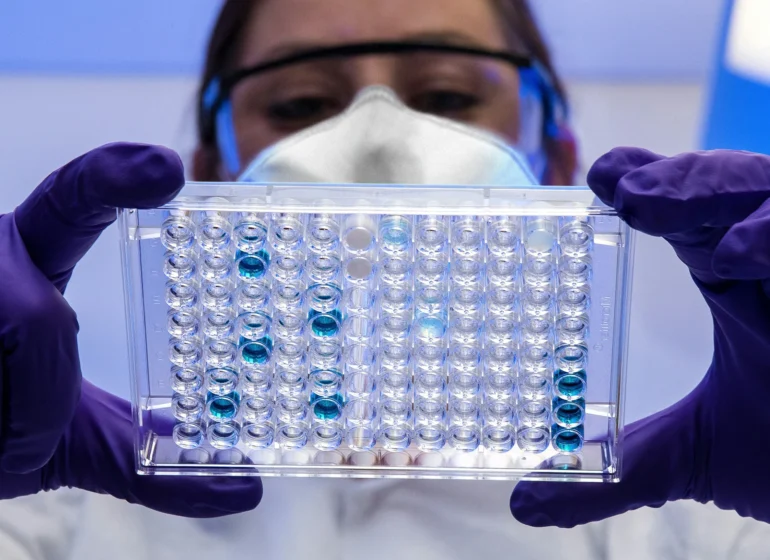
Pharmaceutical automation—the use of robotic systems, AI, and computerised processes to handle drug manufacturing, quality control, and distribution—is no longer optional if you want to keep your competitive edge.
Whether you’re hiring for a pharma company or building your career in the industry, it’s essential to understand how automation reshapes workflows and job requirements.
Don’t assume that you can adapt later! There’s a deep, fundamental shift on the horizon as the technology advances across the pharma industry, and the professionals who understand it early will have leverage that others won’t.
So, what is pharmaceutical automation, and how is it shaping the future? Here’s everything you need to know:
- What is pharmaceutical automation?
- What are the benefits of automation in the pharmaceutical industry?
- Limitations and risks of pharmaceutical automation
- Key technologies in pharmaceutical automation
- Implementation challenges: What slows automation in the pharmaceutical industry down?
- What are the examples of pharmaceutical automation?
- What happens to jobs when the pharma industry automates?
- Future trends in pharmaceutical automation
- Where does the talent come from?
What is pharmaceutical automation?
Pharmaceutical automation covers the technologies that replace or augment manual processes across drug development, manufacturing, packaging, quality testing, and distribution.
This can include:
- Robotic arms handling sterile compounding
- AI-powered systems screening drug candidates
- Automated dispensing cabinets in hospital pharmacies
- Vision systems inspecting tablets for defects
- Other applications to eliminate repetitive tasks and standardise processes across the supply chain
What ties these pharmaceutical automation solutions together is the goal of increasing precision, reducing contamination risks, and maintaining regulatory compliance while scaling production.
The global pharmaceutical manufacturing automation market was valued at $13.5 billion in 2025 and is forecast to more than double to $28.7 billion by 2032. That’s an annual growth rate of 11.3%.
This growth translates to fundamental, irrevocable shifts in pharmaceutical processes and how the industry as a whole defines “operational excellence”.
Pharmaceutical automation in 2026
The shift happening now isn’t about cost savings alone.
Automation has moved from a nice-to-have efficiency tool to a strategic requirement driven by regulatory standards that demand traceability, the rise of precision medicine, and persistent talent shortages that make it difficult to staff manufacturing facilities reliably.
Switzerland, with its concentration of pharmaceutical giants and strict regulatory environment, has been an early adopter.
Basel-area companies have invested heavily in continuous manufacturing systems and automated quality control, partly because Swiss labour costs make automation’s ROI clearer and partly because the regulatory infrastructure supports advanced process controls.
Other countries, such as the US and Germany, are catching up at different speeds.
What’s clear is that automation will only deepen its role in pharma operations.
Companies that treat it as a temporary trend rather than a permanent operational shift will struggle to compete, and professionals who understand how automated systems integrate with existing workflows become more valuable as these technologies mature.

What are the benefits of automation in the pharmaceutical industry?
Automation delivers measurable improvements across safety, efficiency, and compliance.
Studies found that pharmaceutical robots can increase production throughput by 30-50%, reduce product defects by up to 80%, and cut workplace accidents by 70%.
These numbers reflect what happens when robotic systems eliminate the manual steps where mistakes typically occur—pulling the wrong vial from a shelf or miscalculating a dose.
The many advantages of pharmaceutical automation technology are hard to miss:
- Error reduction: Automated systems follow programmed protocols without variation, removing the human factors that cause most medication errors.
- Contamination control: Robotic handling in sterile environments reduces exposure to airborne particles and operator-introduced contaminants.
- Regulatory compliance: Automated documentation creates audit trails that satisfy FDA and EMA requirements for batch traceability and process validation.
- Throughput gains: Machines run continuously without fatigue, increasing production capacity without proportional increases in staffing.
- Cost predictability: Once implemented, automated systems have fixed operating costs that are easier to forecast than labour expenses that fluctuate with hiring markets.
- Worker safety: Automation handles hazardous materials, reducing occupational exposure risks for pharmacy and manufacturing staff.
Beyond operational improvements, automation changes how pharmaceutical companies make strategic decisions. Automated systems generate vast amounts of data that reveal process inefficiencies and patterns, helping to make improvements across capacity planning, resource allocation, and investment priorities.
Automation also shifts what professionals spend their time doing. When machines handle repetitive tasks, pharmacists focus on clinical work, and manufacturing teams solve problems rather than monitor routine operations.
Overall, roles start requiring more judgment and less rote execution.
Together, these benefits create a pharmaceutical industry that can meet higher quality standards while scaling production faster than traditional manual processes allow.
The combination of fewer errors, better documentation, increased capacity, and strategic intelligence means pharmaceutical companies can bring drugs to market more reliably and respond to demand spikes without compromising safety.
Limitations and risks of pharmaceutical automation
Automation solves some problems well, but it doesn’t solve everything—and in some cases, it creates new problems that didn’t exist with manual processes.
The systems work within defined parameters, which means they struggle with exceptions, edge cases, and situations that require judgment calls beyond programmed rules. They’re not human, and they never will be.
Both employers and professionals need to understand these limitations to make informed decisions about where automation fits and where it doesn’t.
The main limitations include:
- Automated systems can’t adapt to unexpected situations the way experienced professionals can
- Software bugs can propagate errors across multiple batches before detection, and system outages can entirely halt production
- Over-reliance on automation creates workforce knowledge gaps, sometimes leaving teams unable to troubleshoot effectively
- Regulatory validation for pharma automation is expensive and time-consuming, with AI and machine learning facing additional scrutiny because frameworks for approving adaptive algorithms don’t yet exist
- Human judgment catches nuances that machines miss, and excessive dependence on automated decision-making can erode critical thinking skills
Overall, pharmaceutical automation comes with its own risks and limitations, and it works best when companies treat it as a tool that complements human expertise rather than replaces it.
It’s now more important than ever to keep experienced professionals in roles that require judgment, adaptation, and sharp decision-making under uncertainty.

Key technologies in pharmaceutical automation
Robotic process automation
Robotic process automation (RPA) uses software to handle repetitive administrative tasks, such as data entry, batch record documentation, inventory tracking, and regulatory reporting.
Unlike physical robots, RPA works with existing computer systems, mimicking the steps a human would take to move data between applications or generate compliance reports. It reduces human errors in documentation and frees staff from tasks that follow fixed rules.
AI and machine learning
AI and machine learning systems analyze patterns in pharmaceutical data to make predictions and optimize processes. For example, in drug discovery, they may screen compound libraries to identify promising candidates faster than traditional methods.
These systems improve with more data, becoming more accurate as they process additional batches and outcomes of the production processes.
Digital twin technologies
A digital twin is a virtual replica of a physical manufacturing process or piece of equipment. It runs simulations based on real-time data from sensors, allowing teams to test process changes, predict how variables affect product quality, and troubleshoot problems without stopping production.
Pharmaceutical manufacturing companies use digital twins to optimise formulations, validate scale-up processes, and train staff on equipment operation.
Automated laboratory systems
Automated laboratory systems handle sample preparation, testing, and analysis without manual intervention. Robotic platforms move samples between instruments, run assays, and record results into laboratory information management systems (LIMS).
These systems increase testing throughput, reduce contamination risks, and generate consistent data that meets regulatory requirements for validation studies and consistent quality control.
Process Analytical Technology (PAT)
Process Analytical Technology uses sensors and analytical instruments to monitor critical quality attributes during manufacturing in real time. Instead of testing samples after production, PAT systems measure parameters like moisture content and active ingredient concentration as the process runs.
This allows immediate adjustments to keep batches within specification and provides the continuous process verification that regulators now expect from pharma manufacturing.
Implementation challenges: what slows automation in the pharmaceutical industry down?
Despite its many advantages, pharmaceutical automation comes with barriers that delay or derail projects, and most of them trace back to money, skills, and resistance to change.
Financial hurdles
Automation requires significant upfront investment, such as equipment, facility modifications, validation studies, and ongoing maintenance. Small and mid-sized manufacturers often struggle to justify the expense and postpone it.
The initial cost of installing automation systems can be high, but organisations must consider long-term returns. For example, studies show a 57% reduction in expired medications contributing to $4.1 million in total annual savings. In other words, gains take time, but they’re almost always worth it.
Technical complexity
Legacy systems don’t communicate easily with modern automation platforms, which means expensive integration work or complete replacements. High-volume manufacturers need systems that scale without creating bottlenecks, and smaller operations need flexibility for frequent product changeovers.
Both require expertise in robotics and controls engineering—skills that remain scarce. This gap can hinder the implementation of automation in the pharmaceutical sector.
Workforce challenges
Employees often resist automation when they fear job loss, and their concerns have merit. With pharmaceutical development, roles change, and some positions end up disappearing.
But automation also creates opportunities for professionals to move into higher-value work when companies invest in training programs that help staff develop skills for automated environments.
Ultimately, to effectively adopt any type of automation technology, investing in workforce training is essential as part of a broader change management and upskilling strategy.
What are the examples of pharmaceutical automation?
Drug discovery
In drug discovery, automation accelerates the process of identifying promising compounds. For example, high-throughput screening robots test thousands of molecules against biological targets in hours instead of weeks.
Clinical manufacturing
Clinical manufacturing uses automated processes to produce small batches of investigational drugs for trials. Automated systems handle formulation, filling, and labeling with the precision needed to meet regulatory requirements.
Commercial manufacturing
Commercial manufacturing relies on automation for large-scale production that still maintains high precision and consistency. Continuous manufacturing platforms—where raw materials enter one end and finished product exits the other—are replacing traditional batch production in some facilities.
Quality control
Quality control automation handles the testing required to release pharmaceutical products. Automated systems can run dissolution tests, measure active ingredient content, check for contaminants, and verify sterility in a highly accurate manner.

What happens to jobs when the pharma industry automates?
Automation doesn’t eliminate pharmaceutical jobs uniformly. It reshapes them. Roles focused on manual handling and repetitive tasks shrink, and positions requiring technical oversight, data analysis, and process optimisation expand.
New roles also emerge around automation itself. Companies need engineers who can integrate robotics with existing workflows, data scientists who can extract insights from production data, and other smart human workers.
The challenge is that these roles require different skills than the positions they replace, which creates gaps when companies scale automation without investing in workforce development.
Overall, the professionals who adapt (learning how advanced technologies work, understanding data integrity requirements, and developing technical skills that complement automated systems) remain valuable. But those who resist the shift find fewer opportunities as manual processes disappear.
Learn more about freelance medical biology and pharma jobs.
Future trends in pharmaceutical automation
Pharmaceutical automation in 2026 is moving toward intelligent manufacturing environments built on artificial intelligence, digital twins, and collaborative robotics.
Digital twin technology has transitioned from pilot projects to a foundational practice across drug discovery and global distribution. These virtual replicas let companies test process changes, train staff, and optimise production without disrupting operations.
AI remains in its infancy from a production perspective, with significant room for adoption.
Current applications focus on predictive maintenance and quality prediction, but the technology will expand into real-time process control and autonomous decision-making as pharmaceutical customers gain confidence in AI-driven systems and regulators develop frameworks for validation.
Overall, the future of pharmaceutical automation relies on integrating these intelligent technologies into traditional workflows without compromising compliance requirements.
Where does the talent come from?
Companies that succeed will be those that treat automation as an ongoing capability to develop rather than a one-time implementation.
They’ll need professionals who understand both the technology and the regulatory environment, people who can bridge advanced analytics with good manufacturing practices.
Whether you’re a pharmaceutical professional looking to build skills in automation technologies or a company searching for talent that can drive your automation strategy forward, Headcount specialises in connecting the right people with the right opportunities in life sciences.
Explore our recruitment solutions for companies and job seekers to find customised solutions that match your goals.