Reviewed and updated by Maurice Thornton on 19 November 2025
Career in life science: a recruiter’s guide following a degree or PhD
Well, now that you’ve sweated it out in and out of the lab, you’ve obtained your degree in life sciences—and it’s time to start your brilliant career. Panic. Or… maybe you should do a PhD?
The more you browse for open positions, the more you feel confused, under- or over-qualified, and uncertain about the exact field you want to work in. Slow down.
Good news: this feeling is normal. As a life-science recruiter, I meet candidates with the same doubts every week. The sector is remarkably broad and evolving fast—shaped by new modalities, regulation, and (increasingly) data and AI.
In this article I’ll put on the table 20+ years in both R&D and Talent Acquisition and walk you through life-science career opportunities and the habits that actually move you forward.
But first, the evergreen question I get at least once a week: do I need a PhD to work in biotech, medtech, digital health, or pharma?
pssst, if you already have a PhD, feel free to jump straight to the following paragraph.
Working in life science after a degree: PhD or not?
Short answer: it depends on your long-term goals. But you still don’t know for sure what you want to do! If you find yourself in this vicious circle, and you can’t make a decision on such a crucial point of your life science career, this is my 5 cents.
- If you’re aiming at deep R&D roles (or want to keep that door open), a PhD is often expected—especially where you’ll drive hypothesis, design, and authorship.
- If you’re pulled towards industry and product (product management, market access, medical affairs, sales, or operations), real-world experience can outrank additional years of study. If “Market Access Director” is on your 10–15-year horizon or you aim to become the best salesperson of the year in a Medical Device career path, it’s perfectly rational to stop after a Master’s and stack 3–4 years of high-quality experience instead of a PhD.
- If you have a strong passion for Research, want to become a leading expert in your field and aspire to teaching at the university level or working in academia, now or in the next 20 years, a PhD may be a wise choice.
It’s the first crossroads in your career. Evaluate the pros/cons—and, yes, think in 20-year horizons, not 20 weeks.

A quick rule of thumb
Practical industry roles and optionality? A PhD may not be the best fit for you.
That’s it: if you are more interested in practical applications or industry roles or – pay attention here – you are that type of person whose interest and goals may evolve and change over the time, a PhD program may not be the best fit.
What can you do with a life science degree or PhD? Trending job opportunities
As a multidisciplinary field, life science offers career opportunities for research, development, innovation, and the application of scientific knowledge to real-world challenges. It undoubtedly is a dynamic and rewarding field for those passionate about the living world and its intricacies. But it is also a sector with remarkable growth potential, now more than ever.
Since the life sciences are interconnected, a degree becomes just one of many pieces to finding a career path that suits you. Don’t overthink it: your degree in chemistry could easily lead you to a position in biotech!
The outlook is constructive: across life, physical and social science occupations, employment is projected to grow faster than average from 2024–2034, with about 144,700 openings per year in the U.S., driven by growth and replacement needs—useful as a global signal for demand.1
According to Indeed – and us – roles you’ll repeatedly see hired across biotech/medtech/pharma include:
- Clinical/Lab Technician
- Microbiologist / Biologist
- Chemist
- Biomedical Engineer
- Epidemiologist
- R&D Engineer / Clinical Research Scientist

You have noticed that product and marketing roles are not listed here, right? However, rest assured that if these are the global most in demand positions, there are plenty of open positions in regulatory, safety, IT and commercial roles. Just check our jobs section!
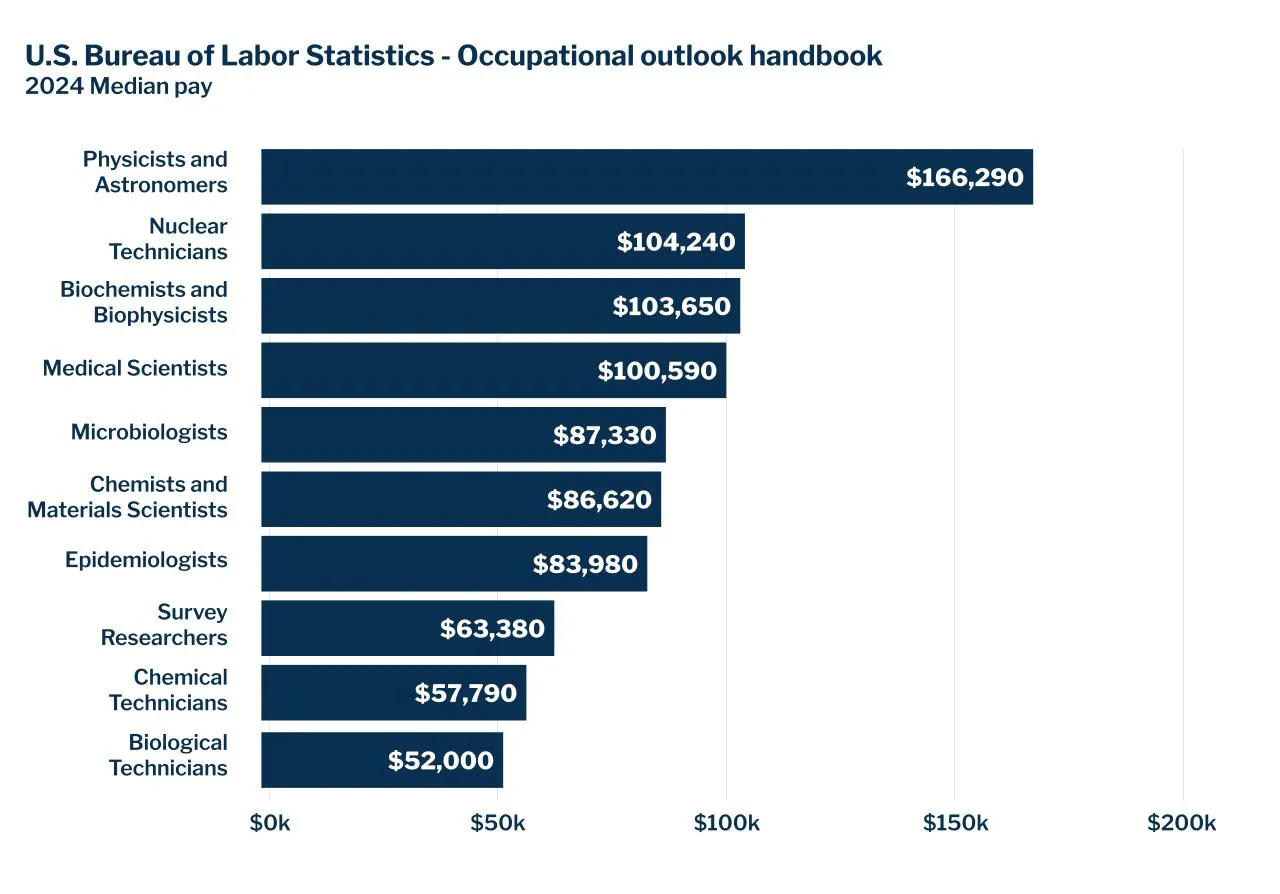
So, these are traditional roles, but what about brand new AI-based opportunities?
New and emerging roles - hello, AI
The shift isn’t theoretical anymore: it’s actively reshaping job descriptions, team structures, and even what “scientist” or “engineer” means in life sciences. Companies are internalizing computational expertise they once outsourced, and this is creating hybrid roles that don’t fit neatly into the old wet lab vs dry lab categories.
Beyond the roles already listed — AI Drug Discovery Scientist, Bioinformatician, ML Engineer, Data Product Manager — new niches are emerging at the intersection of biology, automation, data engineering and generative AI:
- Computational/AI Pharmacologist
Experts who blend predictive models with preclinical and translational data to guide go/no-go decisions, molecule prioritization, and early safety assessments. - Automation & High-Throughput Engineer
As labs become semi- or fully automated, companies need engineers who design robotic workflows, manage advanced LIMS, and translate experimental needs into reproducible, scalable processes. - AI Quality & Model Governance Specialist
When algorithms influence clinical, R&D, or regulatory decisions, someone must ensure traceability, validation, and compliance. This role is expanding rapidly in companies applying ML to biomarkers, diagnostics, or patient-level modeling. - Scientific Prompt Engineer / Knowledge Engineer
Not a fad. More organisations now hire specialists who curate scientific datasets, ontologies and RAG pipelines, structuring domain knowledge so LLMs can reliably support researchers and medical teams. - Translational Data Lead
Hybrid roles connecting multi-omics, clinical, and real-world evidence to identify early signals of efficacy and safety. Highly sought after in platform biotech, immuno-oncology, and precision medicine.
The common denominator?
Domain knowledge + computational literacy compounds over time.
You don’t need to be a full-stack ML engineer, but baseline proficiency in Python, statistics, modeling, and data handling is no longer “nice to have” — it’s becoming an expected part of scientific roles that used to be fully experimental.
Roadmap for successful career in life science - from a recruiter
At headcount we speak science, and as a life science graduate eager for a brilliant and satisfying career – whether if you graduated last month or five years ago – you undoubtedly understand us. So we will go straight to the point: how to ride the wave of the deep changes in the industry without feeling overwhelmed or overshadowed by the competition – aka by your classmate who hasn’t had the chance to read our blog?
1. Start with a solid foundation - but don’t believe that’s enough
A strong degree (biology, biochemistry, pharmacology, etc.) from a top-tier university is a starting point. Stand-out candidates show a pattern of continuous learning (workshops, short courses, micro-certs). Soft skills—teamwork, communication, problem-solving, adaptability—are non-negotiable.

If you want to build a career in regulatory, then obtaining targeted certifications can make a real difference. EU Good Laboratory Practices (GLP) or Good Manufactory Practices (GMP) or specialised regulatory affairs certifications are in this case very useful pieces of paper.
2. Stack practical experience early - and leverage it
Whether you are still a student, a newbie or have been in the job market for 1-3 years, make gaining practical experience an absolute priority. Internship, co-op programs, research positions are highly evaluated by recruiters.
And once you have these experiences, leverage them: mention them in your resume, refer to them during interviews and highlight the skills and contributions you made.
3. Stay relevant - or accept someone else will take your place
Once you’ve secured your dream job (at least for now) try to stay relevant for the company’s transformation. Continued education is a solid strategy to put yourself in the position of being able to pivot your career towards high-value and high-demand roles when the opportunity arises.
Also, don’t forget to keep moving. I see a lot of excellent talents make the mistake of sitting still on their roles, doing what they asked for (right) but never asking for the next challenge. Laying on your role and failing to be proactive makes you less and less relevant each single passing day.
Making mid-career changes in life science is NOT as difficult as it may seem, especially when pursuing internal changes within a company. Being well perceived internally, knowing the company, the people, and the products can make this transition smoother. Capitalize on this opportunity!

4. Network - especially when you don’t “need” to
Long story short: I’ve had many people with 500k+ packages get unexpectedly laid off, terrified about what to do next. Building a strong professional network within the industry gives you the possibility to pick up the phone and secure a new brand-new job in less than six months (which I’d say is average at VP level).
Even if you land in a good position, where you feel secure and satisfied, keep attending industry events, join professional associations, and connect with colleagues on platforms like LinkedIn. If you have an entrepreneurial mindset, you might consider going independent or starting a consulting business once you have appropriate experience.
This isn’t just theory. Market signals in Europe and Switzerland reinforce the point: Europe’s pharma workforce counts 950k people and invests €55bn in R&D each year, while Swiss biotech has stayed resilient with CHF 7.2bn in revenues and rising CDMO employment.2
In a landscape that broad and active, visibility and relationships matter as much as technical skill — because the next opportunity often comes from the people who already know your work.
The future: technology x market growth
The sector will keep growing, but the real shift is in how work is done. Market demand remains strong, driven by ageing populations, chronic diseases and a continuously expanding R&D ecosystem. But opportunity doesn’t translate into automatic entry: companies want professionals who adapt fast, collaborate across functions, and understand how technology reshapes their piece of the value chain.
And this is where a key point stands: a PhD is still an excellent long-term investment if you want deep scientific leadership, academic optionality or high-impact R&D roles. Over a 20-year horizon, it still opens doors and builds authority.
At the same time, emerging roles are changing the rules. In computational biology, data science, AI-assisted R&D, product and translational functions, a PhD has shifted from mandatory to “nice to have”. Domain knowledge plus technical fluency can be just as competitive — sometimes even more.
In short: the industry will evolve quickly, and the people who thrive will be those who keep learning, stay cross-functional, and choose the path that supports their long-term goals rather than what used to be “the only way in.”